|
About
Rashi
General
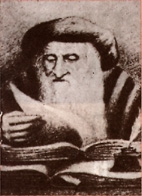
Rabbi Shlomo Yizhaki, better known by his initials, Rashi, though no
longer read and studied as widely and assiduously as in previous
generations, is still accepted as the authoritative commentator on the
Bible and Talmud. Rashi's commentaries accomplished the remarkable feat
of interpreting the Bible in terms of eleventh-century Franco-German
Jewry.
Rashi's role in the history of Jewish culture can best be summed up in
the words of the fourteenth-century Spanish Rabbi Menahem ben Zerah,
"(Rashi) wrote as if by divine inspiration...Without him the Talmud
would have been forgotten in Israel." In spite of the widespread fame
that Rashi attained during his lifetime and the many studies of this
works by generations after him, precious little is known about him as a
person. |
|
Early Life
Rashi was born in 1040 in Troyes, the capital
of Champagne in northern France. Rashi married young and had three
daughters. Like other scholars of his day who were eager to pursue
their education, Rashi traveled to Worms and Mayence, centers of Jewish
learning in Germany. After spending eight years of study in Germany, he
returned to his native city of Troyes at the age of 25 where he began
his lifelong career of teaching and writing. Soon after, he organized a
Talmudic school of his own, and hundreds of students flocked to receive
the benefits of his vast erudition and distinctive method of
interpretation.
Relations with Non Jews
Though close social and ecomonic
contacts existed between the Jews and their non-Jewish environment,
there was little common ground in the area of religious and cultural
ideas and practices. Owing to strong spiritual and communal disciplines
from within and the rivalries between the political interests of the
church and state from without, Jews of Troyes and neighboring
communities enjoyed rights and privileges accorded to ecclesiastics,
noblemen, and the ruling counts vassals. They were free to choose their
residences, and rulers could not legally seize the property of Jews who
had decided to move to other locations. The Crusades in 1096 brought an
era of lawlessness and persecution and those rights and privileges were
curtailed. The Crusades also renewed disputes with Jews in regard to
the merits of Judaism and Christianity.
Traditionalist and Realist
Rashi's commentaries and writings reveal familiarity not only with the
wine industry in which he engaged but also with such subjects as
carving, engraving, falconry, fishing and bee husbandry, glasswork,
botany, ship repairs, and military affairs. This wide range of interest
undoubtedly contributed to what might be described as Rashi's pragmatic
and wholesome views on a number of questions of Jewish law and practice.
Major Contributions
The secret of Rashi's influence is to be sought chiefly in his methods
and skills as a commentator and teacher. Rashi's contribution consists
in his blending of both peshats, literal exegesis, combinded with
derash,free interpretation and homiletic comment. Also when Rashi was
in doubt as to whether his contemporaries would understand a certain
Hebrew or Aramaic term, he did not hesitate to translate it into
French. He used some three thousand French words, which have been
studied by scholars of Romance languages as an important source of
information about the French language of the eleventh century.
From "Rashi" by Samuel Blumenthal,
in: Great Jewish Personalities in Ancient and Medieval Times.
|